HeLa MCP Ecosystem Architecture
Referensi
docs/architecture.md
Isi dalam bahasa sumber. Unduh sumber · Semua dokumen
This document provides a comprehensive architectural reference for the HeLa MCP Ecosystem, detailing its cellular design principles, dual-backbone topology, component taxonomies, and cross-MCP communication mechanisms.
Current package versions and feature-dependent tool counts are generated in current versions. Each of the ten MCP cells has its own version; the ecosystem snapshot and optional runtime have independent versions.
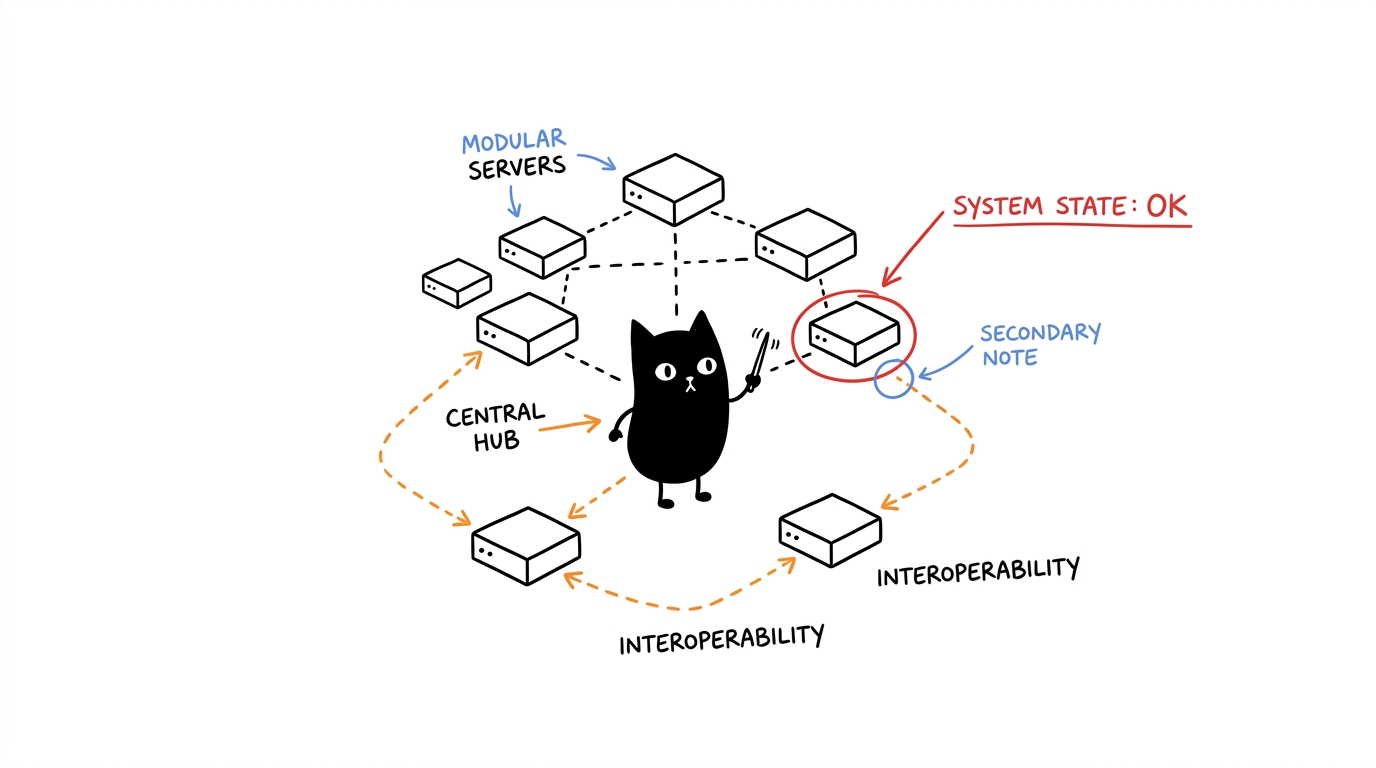
1. Architectural Philosophy: The Cellular Metaphor
The HeLa MCP Ecosystem is architected around a cellular biology metaphor, respectfully recognizing Henrietta Lacks (1920–1951) and the immortal legacy of HeLa cells in biomedical research:
- Cellular Specialization: In biological systems, organelles perform distinct biochemical functions while cooperating as a unified organism. In the HeLa ecosystem, servers act as specialized cellular components (Nucleus, Membrane, Enzyme, Ribosome, Plastid) coordinated by a dual backbone.
- Reproducible source selection: Commit-pinned snapshots under
config/snapshots/select known revisions. Platform dependencies and external integrations still require separate validation. - Repository Autonomy: Underlying repositories, Git histories, and package dependencies remain completely autonomous and uncoupled.
2. The 4-Tier Naming Architecture
To balance brand clarity, backwards compatibility, and technical provenance, the ecosystem enforces a 4-tier naming model:
flowchart LR
    T1["Tier 1: Public Identity<br/>HeLa Genome"]
    T2["Tier 2: Machine ID<br/>hela-genome"]
    T3["Tier 3: Technical Repo<br/>project-mcp"]
    T4["Tier 4: Immutable Commit<br/>72bca15ebe..."]

    T1 --> T2 --> T3 --> T4
- Tier 1 (Public Identity): Clean, uniform human-facing persona name (e.g. HeLa Mitosis, HeLa Genome, HeLa Membrane).
- Tier 2 (Machine Identifier): Stable hyphenated identifier (
hela-*) used in configuration files (mcpServers), CLI flags, and profile definitions. - Tier 3 (Technical Source Repo): Independent Git repository name on GitHub maintaining upstream authorship and commit history.
- Tier 4 (Immutable Commit Pin): Exact SHA-1 hash recorded in
config/snapshots/ensuring reproducible builds.
3. Dual-Backbone Coordination Topology
Every deployed profile in the ecosystem is grounded by a dual backbone:
flowchart TB
    Client["AI Client / Orchestrator"]

    Mitosis["HeLa Mitosis<br/>(hela-mitosis)<br/>- Dynamic Routing<br/>- Step Reasoning<br/>- Task Decomposition<br/>- Prompt Catalog"]
    Genome["HeLa Genome<br/>(hela-genome)<br/>- Knowledge Graph<br/>- Living SQLite DB<br/>- Entity / Relations<br/>- Milestones & State"]

    Membrane["HeLa Membrane<br/>(Files)"]
    Nucleus["HeLa Nucleus<br/>(Exec)"]
    Ribosome["HeLa Ribosome<br/>(PTY)"]
    Enzyme["HeLa Enzyme<br/>(Search)"]
    Cytosol["HeLa Cytosol<br/>(Browser)"]
    Phenotype["HeLa Phenotype<br/>(Design)"]

    Client -- "stdio JSON-RPC" --> Mitosis & Genome
    Mitosis <-->|"Shared Memory"| Genome
    Mitosis & Genome --> Membrane & Nucleus & Ribosome & Enzyme & Cytosol & Phenotype
- HeLa Mitosis (Routing & Planning Backbone): Bundled Needle 3 agent runtime (plan → execute → observe with recorded AgentState), suggests multi-step execution paths, Needle-backed sequential analysis, and serves 40 curated domain prompts. Offline-first; OpenRouter is an escalation backend only.
- HeLa Genome (State & Memory Backbone): Maintains the living SQLite knowledge graph (
memory.db), restores cross-session context, records task states, and manages project milestones.
4. Component Taxonomy
4.1 Core Backbone Servers
1. HeLa Mitosis (hela-mitosis / chaining-mcp)
- Role: Orchestration, dynamic routing, and Needle-backed sequential reasoning.
- Entrypoint:
dist/index.js - Tools:
agent_run,sequentialthinking,analyze_with_sequential_thinking,analyze_tools,generate_route_suggestions,llm_decompose_task,llm_suggest_route,workflow_orchestrator,workflow_status,workflow_cancel,list_skills,search_skills,get_skill,suggest_skill_chain, plus prompt/resource, time, and validation tools. - Zero-Key Behavior: The bundled Needle 3 agent runs fully offline. Without
OPENROUTER_API_KEY, escalation hands control back to the calling agent (handoff: true) with the full state trail — never a fabricated answer.brainstormingis the one exception: it needs a generative model and fails honestly without a key.
2. HeLa Genome (hela-genome / project-mcp)
- Role: Living memory graph, entity-relation-observation state tracking.
- Entrypoint:
dist/index.js - Tools:
memory_edit(entity/relation/observation CRUD),read_graph,search_nodes,get_session_context,sync_central_memory,security_scan, and the three mission toolscreate_mission,list_missions,update_mission. - Storage: Embedded SQLite database (
memory.db) with FTS5 full-text indexing.
4.2 Core Capability Servers
3. HeLa Membrane (hela-membrane / filesystem-mcp)
- Role: Sandboxed workspace filesystem operations and search.
- Entrypoint:
dist/index.js - Tools:
read_file,write_file,find_files,search_in_files,copy_file,move_file,delete_file,archive_files.
4. HeLa Nucleus (hela-nucleus / terminal-mcp)
- Role: Isolated command execution and RTK token optimization.
- Entrypoint:
build/index.js - Tools:
execute_command,transfer_file,terminal_ls,terminal_grep,terminal_cat,terminal_session_close,terminal_session_list.
5. HeLa Ribosome (hela-ribosome / menager-mcp)
- Role: Polyglot interactive PTY session multiplexing and Regex hook engine.
- Entrypoint:
build/index.js - Tools:
session_spawn,session_write,session_read,session_hook,session_close,session_list,session_prune.
6. HeLa Enzyme (hela-enzyme / researcher-mcp)
- Role: Unified research platform: zero-key dual-tier web search + arXiv + Google News RSS + Wikipedia caching.
- Entrypoint:
dist/index.js - Tools:
google_search,wikipedia_search,wikipedia_get,content_summarizer,fact_checker,keyword_extraction.
7. HeLa Cytosol (hela-cytosol / browser-mcp)
- Role: Playwright-based browser automation and DOM accessibility perception.
- Entrypoint:
src/server.js - Tools:
browser_navigate,browser_screenshot,browser_click,browser_type,browser_get_content.
4.3 Specialized Capability Servers
8. HeLa Phenotype (hela-phenotype / designer-mcp)
- Role: UI/UX design tokens, OKLCH palettes, and Tailwind component synthesis.
- Entrypoint:
dist/index.js - Tools:
design_tokens,palette,design_audit,generate_template,logo_workflow.
9. HeLa Receptor (hela-receptor / scrcpy-mcp)
- Role: Android mobile device control via ADB bridge.
- Entrypoint:
dist/server.js - Tools:
start_session,ui_dump,ui_find_element,tap,swipe,input_text,screenshot.
10. HeLa Plastid (hela-plastid / ll3m-mcp)
- Role: Autonomous 3D procedural modeling and rendering in Blender.
- Entrypoint:
dist/index.js(underbrain/) - Tools:
generate_modeling_plan,execute_blender_code,render_output,save_blend,get_fast_feedback.
4.4 Canonical Tool Boundaries (v1.2.0)
Several organelles expose overlapping capabilities. Descriptions and the Mitosis capability router now enforce a single canonical choice per intent, keeping a restricted alternative only for its niche:
| Intent | Canonical | Restricted alternative | Restricted use |
|---|---|---|---|
| Web search | hela-enzyme:google_search |
hela-cytosol:browser_search |
Visual browser workflows only |
| Content extraction | hela-enzyme:extract_content |
hela-cytosol:browser_get_content |
Pages requiring client-side JavaScript |
| Local file read | hela-membrane:read_file |
hela-nucleus:terminal_cat |
Remote SSH targets only (host required) |
| Memory-graph inspection | hela-genome:execute_sql / query_data |
hela-ribosome:opencode_db |
OpenCode session database only |
Tool names are unique ecosystem-wide after the Phase 1 rename, so the router matches boundaries by tool name without needing a server field.
4.5 HeLa Runtime (optional daemon, hela-runtime)
The optional runtime supervises child MCP processes behind one stdio or Streamable HTTP endpoint. Its generated catalog exposes selected-profile schemas without starting cells. The first invocation starts only its target; concurrent first calls share startup. Unknown tool names do not trigger an all-cell scan.
- Source: https://github.com/Hela-Ecosystem/hela-runtime
- Entry:
hela-runtime/dist/index.js - Serve mode: add
--runtimeto any profile, for example./setup.sh --profile dev-workspace --client opencode --runtime. Runtime is not a profile; an omitted profile defaults tominimal. - Env:
HELA_ECOSYSTEM_ROOT,HELA_PROFILE,HELA_HTTP_PORT,HELA_NAMESPACE_TOOLS. - Features: true on-demand ignition for every selected cell, fingerprinted schema caches, bounded crash/timeout recovery, opt-in namespacing, runtime-internal
hela.pipe, and HTTP/healthzliveness. - Without it: users keep the individual servers selected by their profile and can use
hela-mitosis:workflow_orchestratorfor cross-cell chaining. - Details: on-demand startup, cache invalidation and deployment evidence.
5. Security & Isolation Model
flowchart TB
    Host["Host Operating System / Terminal Environment"]
    Root["HeLa MCP Ecosystem Root"]
    Sandbox["stdio JSON-RPC Sandbox"]
    Membrane2["Path Canonicalization<br/>(HeLa Membrane)"]
    Nucleus2["Explicit CWD & Timeout Limits<br/>(HeLa Nucleus)"]
    Ribosome2["Process Group Teardown<br/>(HeLa Ribosome)"]
    Cytosol2["SSRF IP Filtering<br/>(HeLa Cytosol)"]

    Host --> Root
    Root --> Sandbox & Membrane2 & Nucleus2 & Ribosome2 & Cytosol2
- Process Boundary: Each server runs in an isolated Node.js child process communicating exclusively over standard input/output (
stdio) via JSON-RPC 2.0 messages. - Memory Safety: SQLite database operations in
hela-genomeuse parameterized queries with WAL (Write-Ahead Logging) mode. - Credential handling: Doctor reports presence, not values. Generated client configurations can contain explicitly configured credentials; treat those files and generator output as private. Process separation is not a security sandbox, and remote endpoint authentication/authorization remain explicitly deferred; see security status.
6. Profile System & Lifecycle Management
The ecosystem configuration generator (scripts/generate-config.mjs) reads:
config/inventory.json: Authoritative component catalog, entrypoints, Git repositories, and alias mappings.config/profiles.json: Curated stacks tailored to specific agent personas and hardware targets.
The installer matches the selected profile against the inventory and chosen snapshot, then renders client syntax: mcpServers JSON, OpenCode/Kilo mcp, Zed context_servers, or Codex [mcp_servers.*] TOML. Runtime installation also refreshes selected-profile schema catalogs. All eight profiles are supported; lappy's full ten-cell roster and servy's eight-cell roster are installation choices, not code forks.